Showing posts with label literature. Show all posts

Monday, 10 July 2017

Vampires, Zombies, and Christianity

"Christian archetypes in vampire and zombie myths/texts" is how I worded one topic idea in my ongoing "Research Ideas & Writing Topics" file that I carry around on my mobile phone. I've always had a thing for vampire movies, and although I'm not that into zombie film, I would occasionally watch one. The Korean movie "Train to Busan" (2016) was quite good.


"Gog and Magog consuming humans."
—Thomas de Kent's Roman de toute chevalerie,
Paris manuscript, 14th cent.
A couple of years back it occurred to me that vampires and zombies are actually reconstructions of Christian themes. Drinking the blood of Christ in order to obtain immortality may have been part of the inspiration for the Gothic vampire genre, and the biblical eschatological reference to the Gog and Magog which some have interpreted as a resurrected army of the damned who come to attack the saints and the City of God, which is part of the final battle between God and Satan in the Book of Revelation. In some of the later Alexander myths, such as Thomas of Kent's "Roman de toute chevalerie", Gog and Magog are depicted as zombie-like cannibals that hide in the dark (caves).


In any case, it turns out I'm not the only literature scholar to have noted the connection between these Gothic genres and Christianity. Oxford University Press just published a book by English literature professor Greg Garrett, called "Living with the Living Dead: The Wisdom of the Zombie Apocalypse".

I have not yet read his book, so I'm not sure how much his ideas and my own overlap, but I did listen to an interview with him, in which he discusses his book and the obsession popular culture has with zombie apocalypses and how it connects with religion. You can listen to the interview here: Zombie Time with Greg Garrett

Sunday, 22 May 2016

A Dog of Flanders


Who still remembers the story "A Dog of Flanders", about an artistic orphaned boy Nello and his dog Patrasche? I can't remember what the Afrikaans title was when it aired in South Africa in the 80s. In any case, it turns out that while the story is rather unknown around the world -- even in the native Belgium that is its setting -- it is actually quite popular in Japan and here in Korea where it is considered a great children's literature classic.

Spoiler Alert: In the original book by English author Marie Louise de la Ramée (aka Ouida), Nello and Patrasche freeze to death, but not before succeeding in their journey to see the great paintings of Rubens. (The animated version has a less tragic ending.) I think because I was a rather lonely and artistically inclined child who spend much of my free time drawing, I especially associated with Nello. How different is this story, and others like it such as Heidi and The Wonderful Adventures of Nils (Holgerssons) from today's children's animations! I really believe that these tails of realistic loss and suffering endured by children better prepared me for my future life. These stories taught me that good doesn't always win over evil, that the innocent are not free from suffering. Maybe that is why it is also popular in Korea.

Wednesday, 19 March 2014

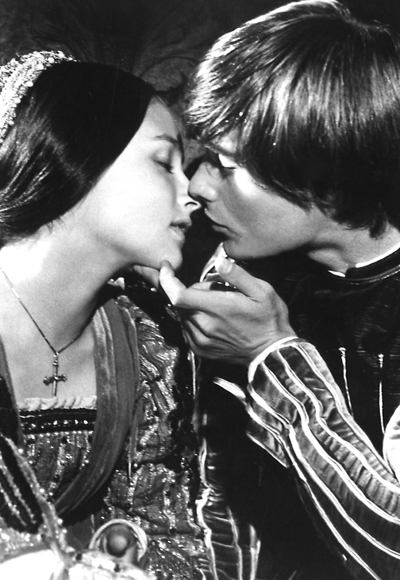
The Palmers' Kiss

In the class I'm teaching on cinematic adaptations of Shakespeare plays, we are spending the first half of the semester looking at adaptations of Romeo and Juliet. One of my favourite parts of the play is Romeo and Juliet's first interaction. What a smooth charmer is that Romeo! He makes out with her, kissing her twice -- three times, actually, if one counts the kiss he planted on her hand -- within quite a short time; somehow convincing her that kissing is like praying. My commentary is in italics.

Image Source


Act 1, Scene 5.

ROMEO
[To JULIET] If I profane with my unworthiest hand
This holy shrine, the gentle fine is this:
My lips, two blushing pilgrims, ready stand
To smooth that rough touch with a tender kiss.

Basically, he takes her by the hand and tells her that since his hands are so rough, he will pay for his indiscretion by kissing her hand.   

JULIET
Good pilgrim, you do wrong your hand too much,
Which mannerly devotion shows in this;
For saints have hands that pilgrims' hands do touch,
And palm to palm is holy palmers' kiss.

Since they are touching hands, Juliet suggests that palms against palms (or hands in prayer) is like a kiss done by saints. 

ROMEO
Have not saints lips, and holy palmers too?

Seeing as they are touching hands, which Juliet suggested is like a kiss, Romeo asks why don't saints kiss with their lips instead.

JULIET
Ay, pilgrim, lips that they must use in prayer.

Because, says Juliet, they are using their lips for praying.

ROMEO
O, then, dear saint, let lips do what hands do;
They pray, grant thou, lest faith turn to despair.

Romeo says that their lips should do what their hands are doing -- touch each other in prayer.

JULIET
Saints do not move, though grant for prayers' sake.

Juliet, to shy to make the move, says that saints don't move.

ROMEO
Then move not, while my prayer's effect I take.

Romeo assures her that she doesn't need to move, he will move, and kisses her.

Thus from my lips, by yours, my sin is purged.

After the kiss he explains that his sins have now been taken away by her lips.

JULIET
Then have my lips the sin that they have took.

Juliet laments that now Romeo's sins are on her lips.

ROMEO
Sin from thy lips? O trespass sweetly urged!
Give me my sin again.

So Romeo states that he will take his sins back, and kisses her a second time.

JULIET
You kiss by the book.

You can read a modern English translation of the text here, and watch a nice modern adaptation of this kiss scene here.

Friday, 24 January 2014

Gianni Schicchi: Vampire or Zombie?

Dante and Virgil in Hell (1850)
by William-Adolphe Bouguereau

I saw this painting and the first thing that came to mind was, cool, a vampire. I mean, look at it, one guy is biting another guy quite ferociously in the neck, and flying above them is some type of batlike man which looks very much like something I've seen in such vampire movies as Bram Stoker's Dracula.

It turns out that this is a painting by Bouguereau. Yes, that Bouguereau. The one who also painted the Cupid and Psyche as Children.

In this painting entitled Dante and Virgil in Hell (not to be confused with The Barque of Dante by Eugène Delacroix), Bouguereau is depicting a scene from Dante Alighieri's famous Divine Comedy from the 1300's. In the first part of the poem called Inferno the characters Dante and Virgil are led through different levels of hell. This particular scene is in the eighth circle of hell where falsifiers (liars, counterfeiters, and so on) are kept.

In Canto XXX it reads:

As I beheld two shadows pale and naked,
Who, biting, in the manner ran along
That a boar does, when from the sty turned loose.
One to Capocchio came, and by the nape
Seized with its teeth his neck, so that in dragging
It made his belly grate the solid bottom.
And the Aretine, who trembling had remained,
Said to me: "That mad sprite is Gianni Schicchi,
And raving goes thus harrying other people."

So there I have it. In this painting Gianni Schicchi is not a vampire sucking the blood of Capocchio. But he could be a zombie though.


As is so succinctly paraphrased in one commentary: "That goblin is Gianni Schicci, and he goes, rabidly, mangling others like that."

Tuesday, 26 November 2013

Common Book Themes

So you are thinking of writing a book, but don't know what about? How about starting with choosing one or two primary themes. I like this list of 101 Common Book Themes by About.Com. Actually, I came upon this list recently while preparing one of my freshmen classes; I imagine our topic for the day was something like themes and archetypes.


  • Beauty of simplicity
  • Capitalism – effect on the individual
  • Change of power - necessity
  • Change versus tradition
  • Chaos and order
  • Character – destruction, building up
  • Circle of life
  • Coming of age
  • Communication – verbal and nonverbal
  • Companionship as salvation
  • Convention and rebellion
  • Dangers of ignorance
  • Darkness and light
  • Death – inevitable or tragedy
  • Desire to escape
  • Destruction of beauty
  • Disillusionment and dreams
  • Displacement
  • Empowerment
  • Emptiness of attaining false dream
  • Everlasting love
  • Evils of racism
  • Facing darkness
  • Facing reality
  • Fading beauty
  • Faith versus doubt
  • Family – blessing or curse
  • Fate and free will
  • Fear of failure
  • Female roles
  • Fulfillment
  • Good versus bad
  • Greed as downfall
  • Growing up – pain or pleasure
  • Hazards of passing judgment
  • Heartbreak of betrayal
  • Heroism – real and perceived
  • Hierarchy in nature
  • Identity crisis
  • Illusion of power
  • Immortality
  • Individual versus society
  • Inner versus outer strength
  • Injustice
  • Isolation
  • Isolationism - hazards
  • Knowledge versus ignorance
  • Loneliness as destructive force
  • Losing hope
  • Loss of innocence
  • Lost honor
  • Lost love
  • Love and sacrifice
  • Man against nature
  • Manipulation
  • Materialism as downfall
  • Motherhood
  • Names – power and significance
  • Nationalism – complications
  • Nature as beauty
  • Necessity of work
  • Oppression of women
  • Optimism – power or folly
  • Overcoming – fear, weakness, vice
  • Patriotism – positive side or complications
  • Power and corruption
  • Power of silence
  • Power of tradition
  • Power of wealth
  • Power of words
  • Pride and downfall
  • Progress – real or illusion
  • Quest for discovery
  • Quest for power
  • Rebirth
  • Reunion
  • Role of men
  • Role of Religion – virtue or hypocrisy
  • Role of women
  • Self – inner and outer
  • Self-awareness
  • Self-preservation
  • Self-reliance
  • Social mobility
  • Technology in society – good or bad
  • Temporary nature of physical beauty
  • Temptation and destruction
  • Totalitarianism
  • Vanity as downfall
  • Vulnerability of the meek
  • Vulnerability of the strong
  • War – glory, necessity, pain, tragedy
  • Will to survive
  • Wisdom of experience
  • Working class struggles
  • Youth and beauty
  • Monday, 13 August 2012

    The Taming of Smeagol

    "The Taming of Smeagol" by Donato Giancola

    I stumbled onto this absolutely exquisite painting, depicting a scene from J. R. R. Tolkien's The Lord of the Rings. It is by multiple award winning artist Donato Giancola. The title "The Taming of Smeagol" refers to a chapter from the second novel of The Lord of the Rings trilogy, "The Two Towers", in which Frodo and Sam captures Smeagol (Gollum).

    A scene from a staged production of
    Shakespeare's "The Taming of the Shrew",
    directed by Conall Morrisson (2008).
    (Image Source)

    Tolkien's chapter title "The Taming of Smeagol" alludes to Shakespeare's play "The Taming of the Shrew" in which a gentlemen "tames" his stubborn bride into becoming obedient. The "taming" in The Lord of the Rings is summarised as follows on the Tolkien Gateway wiki:

    As the hobbits huddle in the cold, Frodo spots a crawling insect-like creature on a distant cliff, clinging to the wall by its hands. Sam realizes the creature is Gollum. As the creature draws nearer, he leaps on Sam. They wrestle. Frodo draws his knife Sting from its sheath and thrusts it against Gollum’s neck, demanding obedience from the creature. Gollum is suddenly subservient and vows total servitude, but Frodo does not trust him entirely. Gollum suddenly bounds away, attempting escape. The hobbits get him back and harness him with the Elf rope, which causes Gollum great pain. Gollum again vows obedience, and this time he seems sincere. The creature leads his Hobbit masters onward to Mordor.


    Many readers, particularly readers of later generations, have wondered if the relationship between the Hobbits Frodo and Sam are possibly homosexual, considering the strong love the Hobbits have for each other and the physical affection that Sam shows towards his master Frodo. I think this misconception reveals the sad state of modern Western culture where any intimate friendship is assumed to be sexual. As if the only way to intimacy is through sex. No, any close reading of the text makes it clear that the two Hobbits are not homosexual. They do, however, express great camaraderie and platonic intimacy and such physical affection between same-sex friends are quite common in many cultures around the world and carries no sexual significance--not in many parts of our world, nor in Tolkien's Middle Earth.

    The painting by Giancolo, on the other hand, flips the tables and asks a different question; not if there is sexual intimacy between Frodo and Sam, but rather if there is a type of sexual tension between Frodo and Smeagol, or Sam and Smeagol.

    "The Taming of Smeagol" by Donato Giancola

    The homo-erotic elements in this painting is glaringly obvious. The naked Smeagol sits on Sam's back; Smeagol has toppled Sam and mounted him, hinting at an attempted rape. Fortunately Frodo intervenes and pulls Smeagol away by his hair, while keeping "Sting", his sword threateningly close. Frodo's violent action is paradoxically contrasted with his face so intimately close to Smeagol's that it almost appears like Frodo is about to kiss Smeagol. Furthermore, swords are by their very nature phallic symbols and in this painting with its close proximity to the naked Smeagol, the sexual symbolism is obviously alluded to.

    Giancolo's depiction evokes a lover's triangle. Those that have read the book (or seen the movie) will know that an actual lover's triangle between these three characters do not exist. Yet the painting makes us aware of such a possibility nonetheless and we are forced to rethink the relationship of these characters. And so we do find a lover's triangle of sorts--not of Frodo and Sam and Smeagol, but of Frodo and Smeagol and the Ring. Smeagol's obsession with the Ring, his "precious", is stronger than any normal erotic obsession. Smeagol's seeming attempt to get closer to Frodo, i.e. Smeagol's "taming", is based on his obsession with the Ring. While Frodo finds the Ring burdensome, he also becomes infatuated with it, and because he knows that Smeagol understands this infatuation, he feels a special bond with Smeagol. The Ring draws them both to itself, but also strangely to each other. Sam is the one left out, the one "underneath", separated from Frodo and Smeagol's special intimacy. Notice how the menacing sword points at Sam, showing how he is "threatened" by Frodo and Smeagol's connection.

    Giancolo's homo-erotic interpretation highlights the intensity of the Ring's power--brilliantly comparing it to an erotic obsession.

    You can view more of Giancolo's artwork at his website.

    Friday, 16 April 2010

    Some Thoughts on Hamlet

    Currently in my Literature and Visual Arts class we are watching a film adaptation of Shakespeare’s Hamlet. I haven’t read the play in a while so watching the movie—especially this excellent adaptation by Kenneth Branagh—just rekindles my wonder of it. What struck me this time, more so than before, is how similar the questions and ideas are to the 20th century paradigm of Existentialism. It is not merely the famous “To be or not to be” soliloquy that conjures up existentialist ideas; but especially Act 5, Scene 1 in the graveyard where Hamlet considers the fate of such greats as Alexander and Julius Caesar:

    To what base uses we may return, Horatio! Why may
    not imagination trace the noble dust of Alexander,
    till he find it stopping a bung-hole?

    He continues:

    Alexander died, Alexander was buried,
    Alexander returneth into dust; the dust is earth; of
    earth we make loam; and why of that loam, whereto he
    was converted, might they not stop a beer-barrel?
    Imperious Caesar, dead and turn'd to clay,
    Might stop a hole to keep the wind away:
    O, that that earth, which kept the world in awe,
    Should patch a wall to expel the winter flaw

    We all, even history’s giants, die and “returneth into dust,” which in turn becomes clay that “Might stop a hole to keep the wind away.”

    The existentialist seeks personal meaning in his life. Hamlet, the Prince of Denmark, reflects on Alexander the Great, the once Prince of Greece. Few, if any, princes achieved what Alexander achieved, so it makes sense that Hamlet would look up to Alexander. The Grecian Prince models all that a young prince should be: brave, decisive, determined. Qualities Hamlet struggles with. But even with these princely virtues, the Great Alexander still died. What’s the ultimate meaning Alexander achieved, if all that his remains are good for is to “stop a beer-barrel?”

    I’m considering writing an essay on “an existentialist reading of Hamlet”; probably for pyp online. I’m also curious about the references to Protestantism, in what seems to be a setting coloured mostly by Catholicism. Is the reason for Hamlet’s pensive disposition the fact that he attended university in Wittenburg – the university where Martin Luther was a doctor?

    Should we read something from this allusion to Protestantism? Is Hamlet in his sphere paralleling Luther in his? As Luther was a reluctant protester against the corrupt Church, so Hamlet is a reluctant protester against the corrupt Danish monarchy. In both cases events and circumstances push these protagonists to action.

    Just before Hamlet agrees to the dual with Laertes, he states this haunting phrase: “There is special providence in the fall of a sparrow.” Haunting, yes, but it also reveals a certain trust—an acceptance of his fate, be it ill or fortunate. This sparrow reference is an allusion to the words of Jesus: “Are not five sparrows sold for two pennies? Yet not one of them is forgotten by God . . . Don't be afraid; you are worth more than many sparrows” (Luke 5:6, 7). That a prince should compare himself to sparrows, and yet find comfort in it!

    I’m anew roused to the mastery of Shakespeare—and of this play. Here I am in the year 2010, and I stand at awe before something written 400 years ago, long before antibiotics, cars, the microchip, aeroplanes, typewriters or keyboards, or any of the things we think so crucial to our lives. Yet this play has the ability to resonate with me in ways that little of these current necessities have the capability of doing.